Clap
AI-Powered Communication for Autistic Children
Using AI to facilitate creativity and communication through collaborative experiences for children with autism (8-12 years)
Using AI to facilitate creativity and communication through collaborative experiences for children with autism (8-12 years)
Growing up with my cousin Carlos, who was non-verbal and had autism and Down syndrome, I watched how easily he got ignored at family gatherings. But he had these moments of communication in his own way that felt incredibly important to me — moments that others missed completely.
This experience led me to a bigger question later in life: How might we use technology to help different types of minds connect through creativity, instead of forcing anyone to communicate in ways that don't feel natural?
1 million people in France live with autism spectrum disorders. Most creative tools assume everyone thinks and communicates the same way, creating barriers instead of removing them.
Growing up with my cousin Carlos, who was non-verbal and had autism and Down syndrome, I watched how easily he got ignored at family gatherings. But he had these moments of communication in his own way that felt incredibly important to me — moments that others missed completely.
This experience led me to a bigger question later in life: How might we use technology to help different types of minds connect through creativity, instead of forcing anyone to communicate in ways that don't feel natural?
1 million people in France live with autism spectrum disorders. Most creative tools assume everyone thinks and communicates the same way, creating barriers instead of removing them.
My approach
My approach
Step 1: Research with real families
10 stakeholder interviews with parents and specialized professionals (15-20 minutes each, kept informal to protect child privacy)
Step 2: Competitive white space analysis
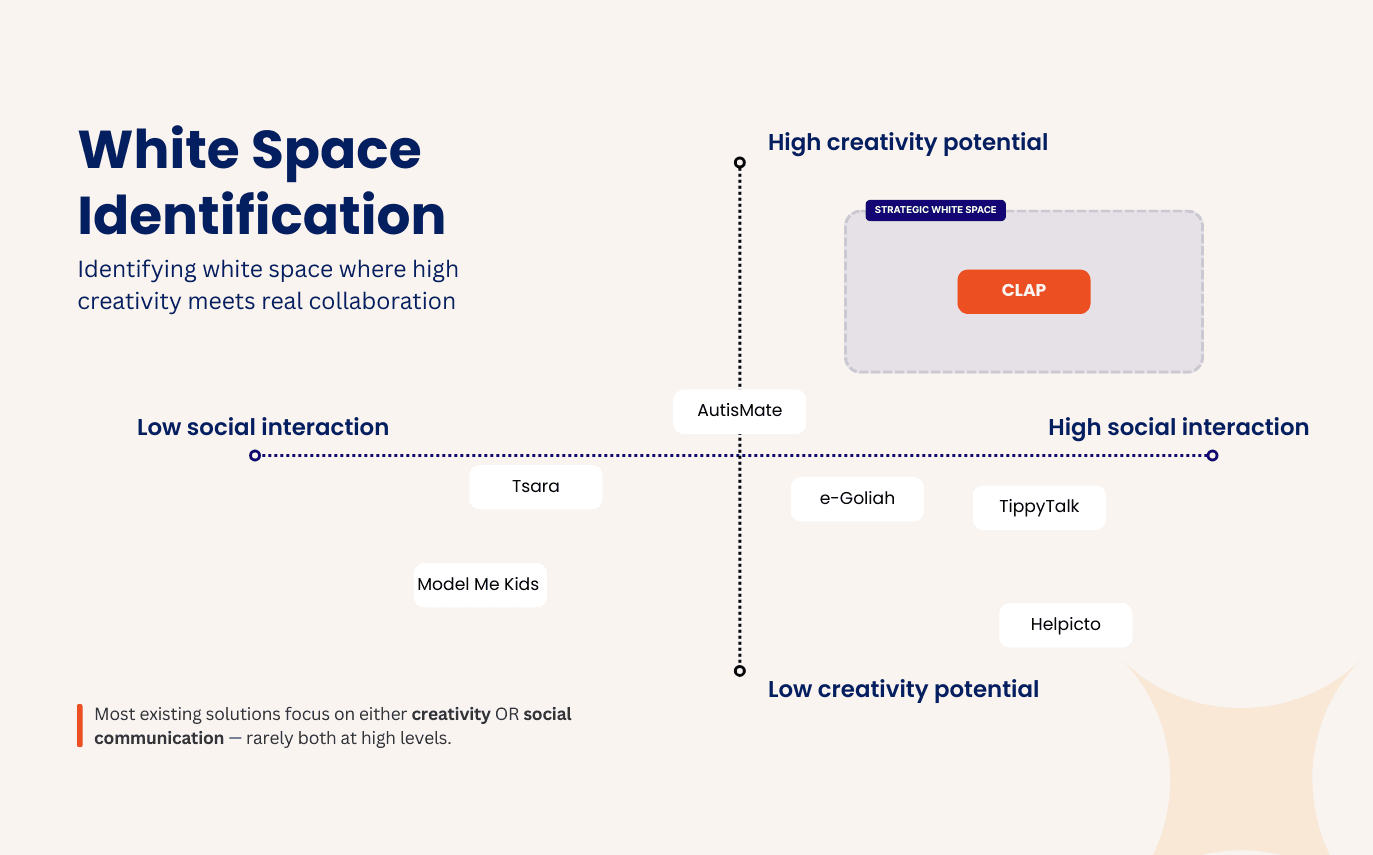
Mapped 6 existing solutions across creative potential vs social interaction — found the gap where high creativity meets real collaboration
Step 3: Solution design with AI adaptation
Golden Circle framework to ensure we were building bridges, not accommodation tools
Step 1: Research with real families
10 stakeholder interviews with parents and specialized professionals (15-20 minutes each, kept informal to protect child privacy)
Step 2: Competitive white space analysis
Mapped 6 existing solutions across creative potential vs social interaction — found the gap where high creativity meets real collaboration
Step 3: Solution design with AI adaptation
Golden Circle framework to ensure we were building bridges, not accommodation tools
Key discoveries
Key discoveries
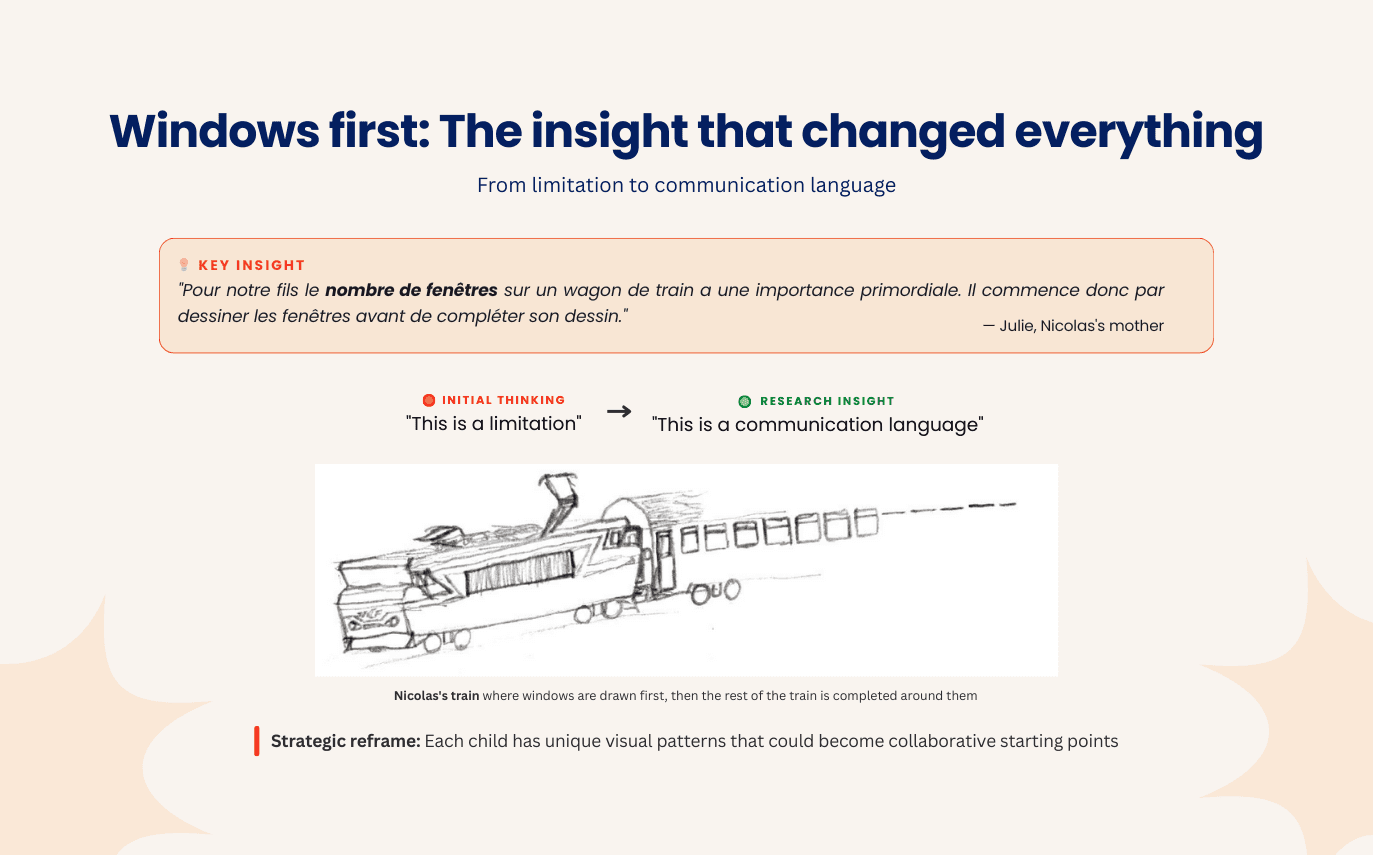
The "windows first" breakthrough: "Pour notre fils le nombre de fenêtres sur un wagon de train a une importance primordiale. Il commence donc par dessiner les fenêtres avant de compléter son dessin" - Julie, Nicolas's mother.
This wasn't a limitation — it was a communication language. Each child has unique visual patterns that could become collaborative starting points.
Social isolation pain: "Le jugement des autres, c'est ce qui me fait le plus mal... plus la différence se voit" - Émilie, mother of 11-year-old.
"À l'école, il n'a qu'un ou deux vrais amis... ses vrais amis en ont marre parfois" - Louis, Antonin's father.
My breakthrough moment: There's no such thing as a "normal" brain — we're all neuro-diverse in our own way. Instead of building tools to help autistic children "fit in," what if we created platforms where every child's natural way of creating becomes valuable for collaboration?
The "windows first" breakthrough: "Pour notre fils le nombre de fenêtres sur un wagon de train a une importance primordiale. Il commence donc par dessiner les fenêtres avant de compléter son dessin" - Julie, Nicolas's mother.
This wasn't a limitation — it was a communication language. Each child has unique visual patterns that could become collaborative starting points.
Social isolation pain: "Le jugement des autres, c'est ce qui me fait le plus mal... plus la différence se voit" - Émilie, mother of 11-year-old.
"À l'école, il n'a qu'un ou deux vrais amis... ses vrais amis en ont marre parfois" - Louis, Antonin's father.
My breakthrough moment: There's no such thing as a "normal" brain — we're all neuro-diverse in our own way. Instead of building tools to help autistic children "fit in," what if we created platforms where every child's natural way of creating becomes valuable for collaboration?
The solution
The solution
Individual Expression Space
AI adapts to each child's unique patterns (trains, windows, specific fixations)
Text or image input accommodates different communication preferences
Personalized responses based on individual traits
Collaborative Canvas
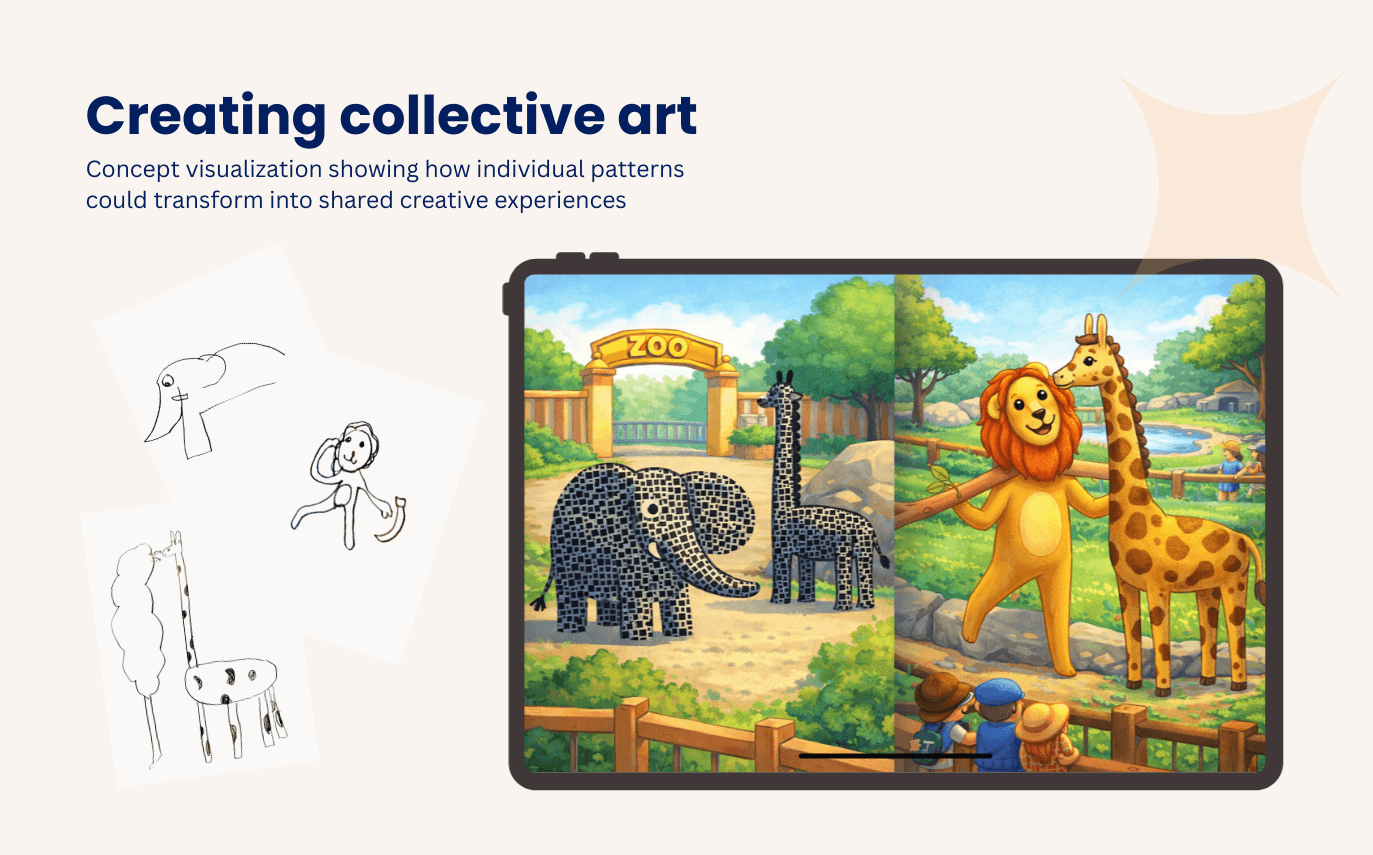
Real-time shared creation space where different thinking styles combine into something bigger than what any child could create alone
AI translates individual patterns into collaborative elements
School environment integration for natural social inclusion
Core insight: The app adapts to the child, not the other way around. If they draw windows first, the AI learns and builds from that pattern. If they're fascinated with animals, the AI creates collaborative scenes in that universe - turning their individual obsession into a bridge for connection with other kids
Technical approach: Tablet app with custom-trained AI models for autism-specific visual communication patterns.
Individual Expression Space
AI adapts to each child's unique patterns (trains, windows, specific fixations)
Text or image input accommodates different communication preferences
Personalized responses based on individual traits
Collaborative Canvas
Real-time shared creation space where different thinking styles combine into something bigger than what any child could create alone
AI translates individual patterns into collaborative elements
School environment integration for natural social inclusion
Core insight: The app adapts to the child, not the other way around. If they draw windows first, the AI learns and builds from that pattern. If they're fascinated with animals, the AI creates collaborative scenes in that universe - turning their individual obsession into a bridge for connection with other kids
Technical approach: Tablet app with custom-trained AI models for autism-specific visual communication patterns.
Validation and testing
Validation and testing
Research methodology:
• 10 stakeholder interviews revealed autism-specific communication patterns
• Competitive analysis revealed genuine white space between creative tools and collaborative platforms
• Wireframe development showing individual → collaborative creation flow
What we actually built: I created wireframes and a simple prototype to test one key assumption: would children naturally engage when their individual creative patterns became part of something bigger?
Testing the concept: At a local centre de loisirs, I set up a low-tech version with 5 kids during art time. Some drew on paper or tablets, others described their ideas to me when drawing felt difficult. I used basic AI tools to combine their elements - acting as the "smart system" to see if the interaction would work.
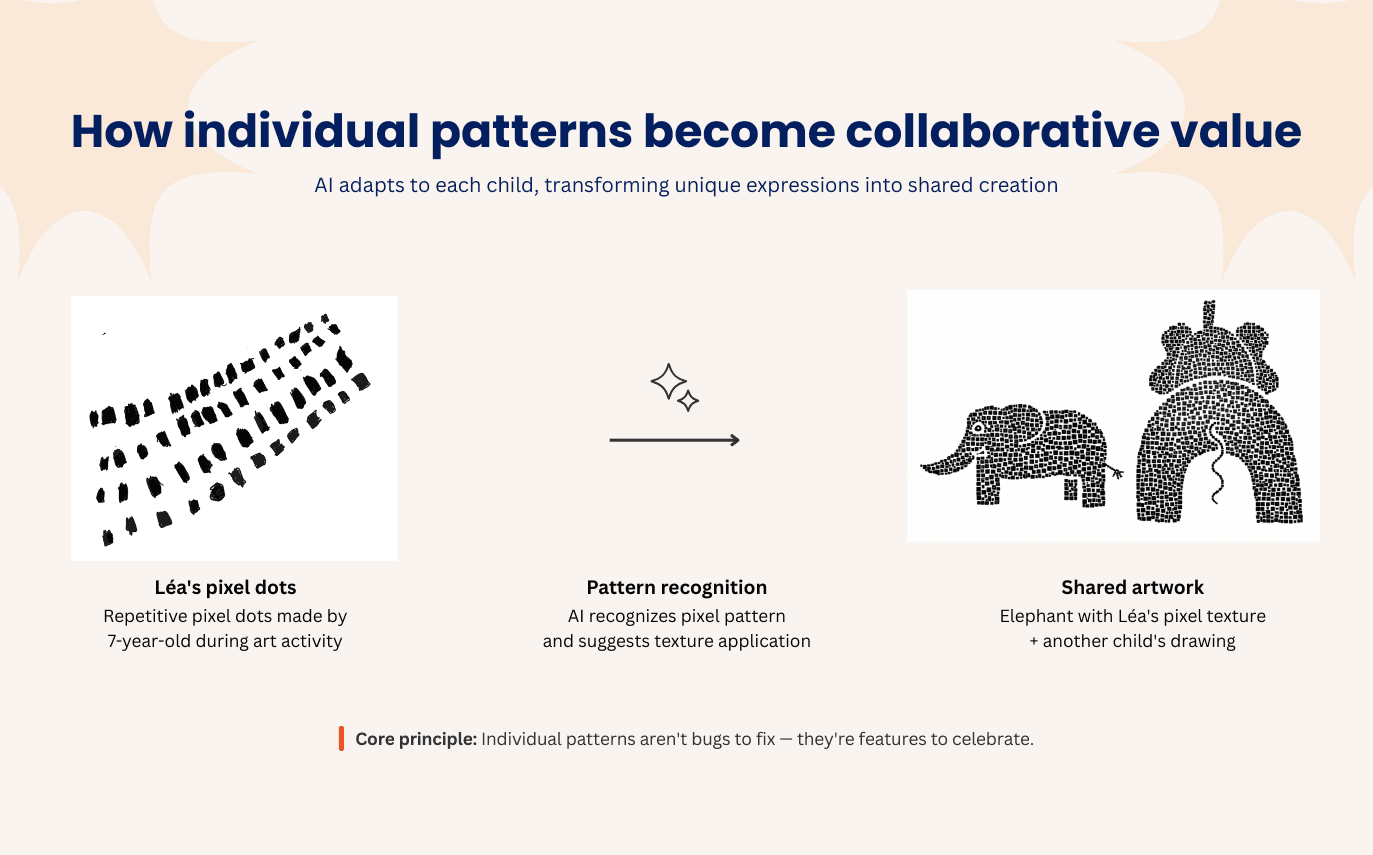
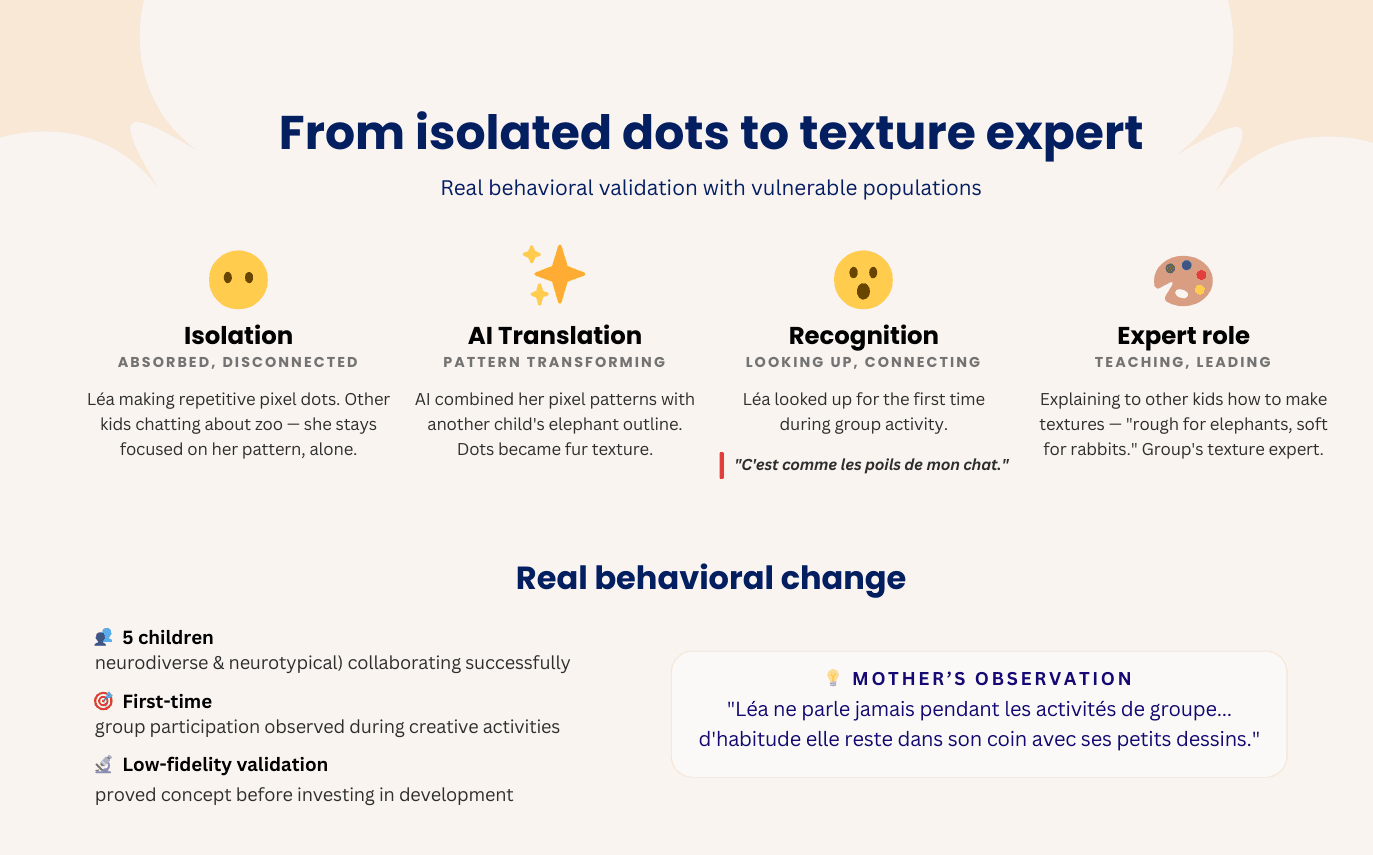
The breakthrough happened with Léa, who spent most of art time making tiny pixel-like dots across her tablet screen - the same repetitive pattern, row after row. Other kids were chatting about drawing animals for a "zoo" theme, but Léa stayed focused on her dots, completely absorbed.
When I used simple AI tools to turn her pixel patterns into animal fur texture and combined it with another child's basic elephant outline, something shifted. Léa looked up for the first time and said quietly: "C'est comme les poils de mon chat." She started explaining to other kids how to make different textures - rough for elephants, soft for rabbits - and suddenly became the group's "texture expert."
Her mother, who was there that day, pulled me aside: "Léa ne parle jamais pendant les activités de groupe... d'habitude elle reste dans son coin avec ses petits dessins."
Results: 5 neurodivergent and neurotypical children successfully created shared artworks, with parents observing first-time group participation during creative activities. The design approach proved transferable to broader inclusive design challenges.
Research methodology:
• 10 stakeholder interviews revealed autism-specific communication patterns
• Competitive analysis revealed genuine white space between creative tools and collaborative platforms
• Wireframe development showing individual → collaborative creation flow
What we actually built: I created wireframes and a simple prototype to test one key assumption: would children naturally engage when their individual creative patterns became part of something bigger?
Testing the concept: At a local centre de loisirs, I set up a low-tech version with 5 kids during art time. Some drew on paper or tablets, others described their ideas to me when drawing felt difficult. I used basic AI tools to combine their elements - acting as the "smart system" to see if the interaction would work.
The breakthrough happened with Léa, who spent most of art time making tiny pixel-like dots across her tablet screen - the same repetitive pattern, row after row. Other kids were chatting about drawing animals for a "zoo" theme, but Léa stayed focused on her dots, completely absorbed.
When I used simple AI tools to turn her pixel patterns into animal fur texture and combined it with another child's basic elephant outline, something shifted. Léa looked up for the first time and said quietly: "C'est comme les poils de mon chat." She started explaining to other kids how to make different textures - rough for elephants, soft for rabbits - and suddenly became the group's "texture expert."
Her mother, who was there that day, pulled me aside: "Léa ne parle jamais pendant les activités de groupe... d'habitude elle reste dans son coin avec ses petits dessins."
Results: 5 neurodivergent and neurotypical children successfully created shared artworks, with parents observing first-time group participation during creative activities. The design approach proved transferable to broader inclusive design challenges.
Key learnings
Key learnings
Individual patterns can scale into inclusive systems. That "windows first" insight taught me that the most powerful tools don't impose standardized interfaces—they adapt to each user's natural communication style.
Working with vulnerable populations changes everything about research methodology. Short, informal interviews weren't just ethical—they were better. Formal usability testing would have missed the nuanced insights that only came from creating truly safe spaces.
The most innovative solutions start with reframing the problem completely. We shifted from "how do we help autistic children communicate better" to "how do we celebrate neurodiversity as a creative superpower." That reframe changed everything about what we built.
Individual patterns can scale into inclusive systems. That "windows first" insight taught me that the most powerful tools don't impose standardized interfaces—they adapt to each user's natural communication style.
Working with vulnerable populations changes everything about research methodology. Short, informal interviews weren't just ethical—they were better. Formal usability testing would have missed the nuanced insights that only came from creating truly safe spaces.
The most innovative solutions start with reframing the problem completely. We shifted from "how do we help autistic children communicate better" to "how do we celebrate neurodiversity as a creative superpower." That reframe changed everything about what we built.
This project taught me that inclusive design isn't about helping 'different' people fit in—it's about creating spaces where everyone's way of communicating has value, so no one gets ignored the way Carlos did.
This project taught me that inclusive design isn't about helping 'different' people fit in—it's about creating spaces where everyone's way of communicating has value, so no one gets ignored the way Carlos did.
This project taught me that inclusive design isn't about helping 'different' people fit in—it's about creating spaces where everyone's way of communicating has value, so no one gets ignored the way Carlos did.
This project taught me that inclusive design isn't about helping 'different' people fit in—it's about creating spaces where everyone's way of communicating has value, so no one gets ignored the way Carlos did.